What Are the Top Types of Multifilament Fishing Nets?
MULTIFILAMENT FISHING NETS are made from many fine fibers twisted or braided into a stronger line. That structure can offer flexibility and a soft feel in the hand. But the best choice depends on more than material. Net construction, mesh size, twine thickness, and intended use all matter.
Common options include nylon, polyester, and polyethylene multifilament nets. Nylon is valued for flexibility and strength, while polyester often holds its shape and resists stretching. Polyethylene may suit some settings where low water absorption is useful. These are broad tendencies, not guarantees. Quality varies by yarn, coating, knot style, and manufacturing.
Construction creates another useful distinction. Knotted nets have joins at mesh intersections; knotless designs use other methods to form the mesh. Each can handle differently during setting, retrieval, and cleaning. Details matter. A net that feels light on a dry counter may behave differently when wet, loaded, or exposed to sun and saltwater.
This guide compares the leading types by material and construction, then explains how mesh dimensions and maintenance affect practical performance. It also considers trade-offs, since durability, visibility, handling, and cost rarely align perfectly in one product. A label alone is not proof. Check product specifications, inspect the mesh and seams, and match the net to its intended fishery and conditions. Local rules can vary, so verify requirements before use. There is no universal “top” net; a careful choice begins with the job, and sometimes the available product information leaves questions unanswered.
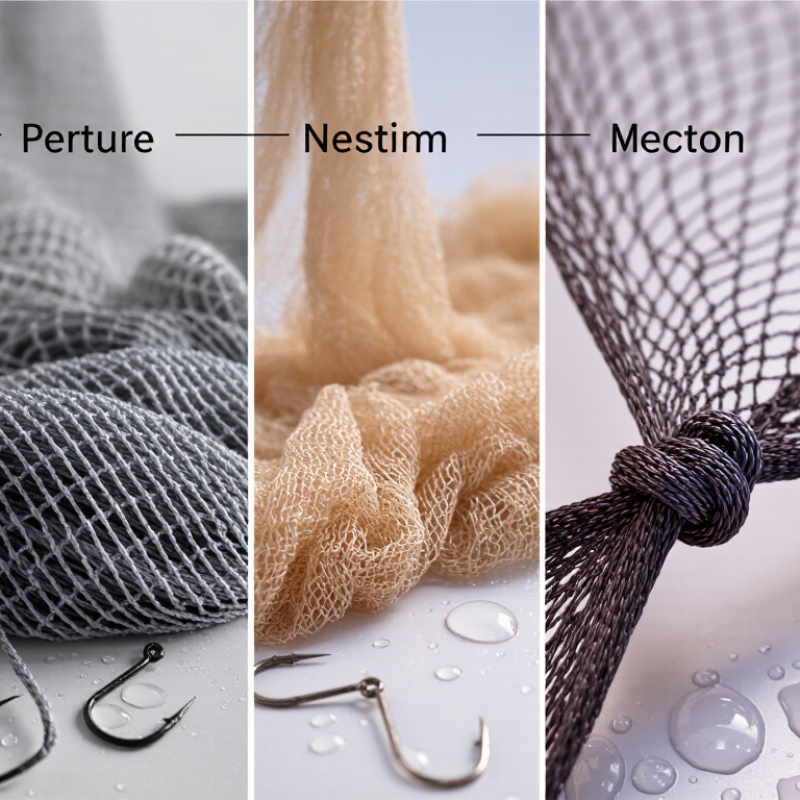
How Multifilament Fishing Nets Are Classified
Multifilament fishing nets are commonly classified by fiber, twine construction, mesh design, and intended use. Nylon is widely used because its bundled filaments create a flexible, abrasion-resistant twine. Polyester options are also available, with different stiffness and water behavior. The fiber name alone does not describe how a net will perform.
Twine may be twisted or braided, and netting may be knotted or knotless. These construction choices affect handling, strength, and how easily the net tangles. Mesh size and mesh shape provide another practical classification. Small, uniform openings suit different fishing conditions than larger or more flexible meshes. Check how mesh size is measured; methods can vary between suppliers.
用途 matters, too. Gillnets, seines, and trawl nets use different layouts and specifications, even when their twine is multifilament. Buyers and net makers often compare twine thickness, mesh dimensions, hanging ratio, and treated or untreated finish. Feel the sample if possible. A label can be tidy while the details are not. In practice, measurements and construction details are more useful than a broad category name, and no single net type fits every setting.
Gill Nets and Their Multifilament Construction
A multifilament gill net is built from many fine filaments twisted or bundled into each twine. Compared with monofilament, this structure can feel softer and more visible in the water. Its flexibility helps the mesh hang naturally, like a loose curtain, while floats hold the headline near the surface and weights pull the lower edge down. Small construction choices matter. Twine diameter, mesh size, hanging ratio, and net depth all affect how fish encounter the mesh. The FAO gear guide describes gillnets as passive fishing gear, with catch shaped by mesh and net configuration (Nédélec and Prado, FAO Fisheries Technical Paper 222, 1990).
For working crews, multifilament netting can be easier to handle and repair, especially when knots or abrasions appear. But it may retain water and debris, and worn fibers can be hard to spot. Check the mesh against a bright background. Look for fuzzy strands, uneven openings, and weak joins. Small details matter. The FAO’s The State of World Fisheries and Aquaculture 2024 reports 92.3 million tonnes of global capture fisheries production in 2022; that figure shows the scale of capture fisheries, not the share caught with gillnets. One caveat: construction alone cannot predict performance. Species, current, setting depth, and maintenance change the outcome, and even experienced net makers may need to adjust a design after field use.
Gill Nets and Their Multifilament Construction
Typical netting-panel arrangements in common gillnet configurations
Single-wall gillnets use one netting panel; double-wall designs use two. Trammel nets typically have three panels: a loose inner panel between two outer panels. Multifilament describes twine made from multiple filaments, not the number of netting panels. Designs can vary by fishery.
Seine Nets for Encircling and Herding Fish
A seine net is designed to surround a school of fish and guide it toward a smaller, controlled area. Multifilament twine is made from several fibers twisted or bundled together, giving the mesh a soft, flexible feel. That flexibility can help the net settle around moving fish without behaving like a rigid wall. It is not a magic solution. Current, fish behavior, and crew timing all matter.
In a beach seine, people haul the two ends toward shore, gradually drawing fish into the middle of the net. A boat seine follows a similar idea offshore, where the vessel helps lay and retrieve the gear. Watch the lead line: it should stay close to the bottom, while floats keep the upper edge near the surface. Small details matter. A slack section can leave an escape route, while a sudden pull may bunch the mesh and make hauling harder.
Net construction should suit the target fish and fishing conditions. Mesh opening affects which fish are retained, and twine thickness influences strength, weight, and handling. Inspect seams and knots before use; small snags can grow during repeated hauling. The net may appear to herd fish on its own, but it does not. The crew, the water, and the net work together—and that coordination is easy to underestimate.
What Are the Top Types of Multifilament Fishing Nets? - Seine Nets for Encircling and Herding Fish
| Seine Net Type | How It Works | Common Use | Multifilament Netting Considerations |
| Purse Seine | The net is set around a school of fish. A purse line running through rings along the bottom is pulled to close the net beneath the fish. | Used to catch schooling pelagic species such as sardines, anchovies, mackerel, and tuna, depending on the fishery and location. | Multifilament netting can be specified for the netting panels. Twine strength, mesh size, hanging ratio, and net depth should suit the target species, vessel, and applicable regulations. |
| Beach Seine | A long net with wings and a central bag or bunt is set from shore or a boat and then hauled in, drawing fish toward the shore. | Used in coastal and inland waters for nearshore fish. Catch composition depends on local habitat, season, and fishing rules. | Multifilament twine can be used in the wings and bunt. The net must be suitable for the bottom conditions and hauling method; abrasion and snagging are practical concerns. |
| Danish Seine | A vessel lays out long ropes and a net around an area. The ropes are hauled in to herd fish toward the net before the net is retrieved. | Commonly used for demersal fish in suitable fishing grounds, with operation and permitted use varying by region. | Multifilament netting may be used in the net body, while the long ropes perform much of the herding. Gear dimensions and operation need to match the seabed and local rules. |
| Scottish Seine (Fly Seine) | Similar to Danish seining, this method uses long ropes to herd fish toward a seine net. The vessel generally moves during the setting and hauling process. | Used for demersal fisheries in areas where the method is permitted and suitable for local seabed conditions. | Multifilament netting can form the net panels, while rope layout and hauling help guide fish. Net design should be selected for the target fishery and operating conditions. |
| Surrounding Seine | The net is set around a group of fish to restrict their movement and guide them toward the enclosed portion of the gear. Some designs also use a purse line. | Used for schooling fish in coastal or open-water fisheries; the exact design and target species vary by fishery. | Multifilament construction is an available netting option. Mesh and twine specifications should balance fishing performance, handling needs, and legal requirements. |
How to Match Net Type to Fishing Conditions
Multifilament gillnets, trammel nets, and seine nets suit different fishing conditions. Match the mesh opening to the target fish, not simply to the net’s advertised strength. Smaller mesh can retain smaller fish, while larger mesh lets them pass. Local catch records and careful test sets are more useful than guesswork. There is no perfect net.
For calm water and targeted fishing, a lighter gillnet can be easier to set and retrieve. In rougher conditions or around abrasive bottoms, stronger twine may last longer, but it can add weight and drag. Trammel nets use layered netting to catch fish that press through the outer panels; they can work well near the seabed, though snags make retrieval harder. Seine nets suit open areas where crews can surround and haul a school. Check the bottom first.
FAO’s The State of World Fisheries and Aquaculture 2024 reports 92.3 million tonnes of capture fisheries production in 2022. That figure describes a varied global sector, not a prescription for one net type. Before choosing, consider water depth, current, seabed, target size, and hauling capacity. A short trial panel can reveal poor mesh fit or excess drag. I would still review the catch afterward; one successful set proves little.