What Are the Top Types of Automotive Oscillators?
Automotive Oscillators help keep vehicle electronics synchronized, from engine control units to digital dashboards and driver-assistance systems. Their timing must remain dependable through vibration, temperature swings, and electrical noise. On a freezing morning, a reliable clock can matter as much as one running beside a hot engine. Small components. Big responsibility.
This introduction compares the main oscillator types used in automotive applications: quartz crystal oscillators, MEMS oscillators, temperature-compensated crystal oscillators (TCXOs), and oven-controlled crystal oscillators (OCXOs). These labels describe different things. Quartz and MEMS refer to resonator technologies; TCXO and OCXO describe temperature-control approaches. The distinctions can be easy to blur, and that matters when selecting parts. A low-cost option may suit a basic control module, while a precision communications system can demand tighter stability.
Dr. John R. Vig, a recognized authority on quartz timing whose published work includes a tutorial on quartz resonators and oscillators, offers a useful principle when paraphrased: “Choose an oscillator for the system’s stability needs, not its label alone.” That is not a direct quotation; it summarizes a practical lesson from his work. The sections ahead examine accuracy, temperature behavior, size, power use, and durability. Real designs involve trade-offs. There is no universal winner, and specifications on a datasheet do not tell the whole story. A careful comparison starts with the vehicle’s operating conditions and the timing task itself.
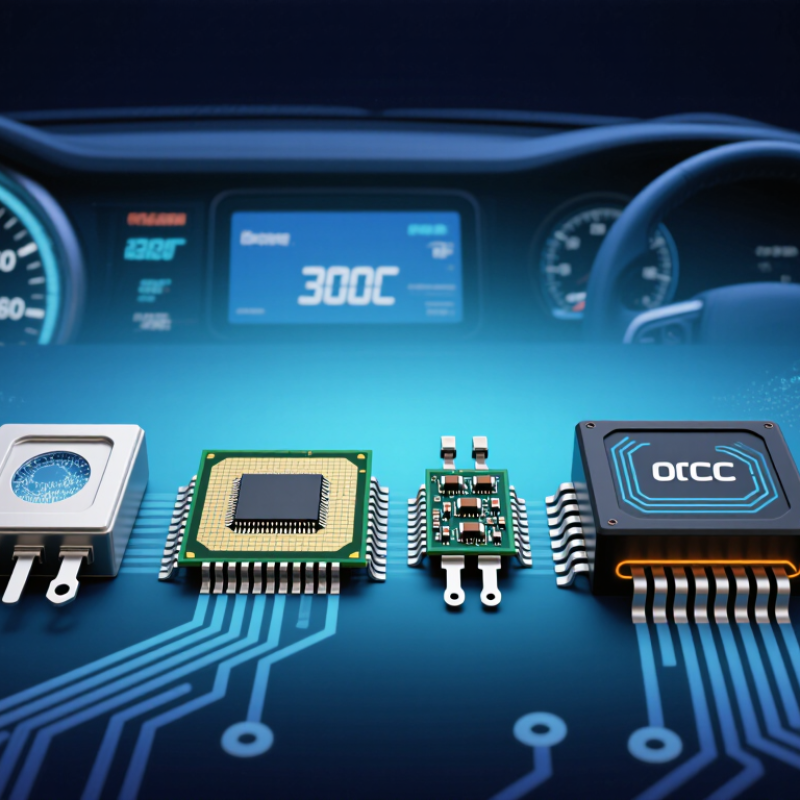
Quartz-Crystal Oscillators: The Established Reference for Automotive Timing
Quartz-crystal oscillators remain an established timing reference in automotive electronics. Their resonant quartz element offers predictable frequency, low jitter, and decades of engineering experience. An engine-control unit may use a compact oscillator to coordinate sensor sampling and communication buses. Small errors matter: at 40 MHz, a 20 parts-per-million offset equals 800 Hz. That figure is illustrative; actual limits depend on the circuit and operating temperature. Quartz is not magic.
Selection should consider temperature drift, aging, vibration, and startup behavior—not just the frequency printed on a datasheet. NIST’s Handbook of Frequency Stability Analysis (SP 1065) explains why stability measurements depend on averaging time, making a single ppm figure incomplete. Automotive qualification also evaluates environmental stress, including temperature and mechanical exposure. Designers should check the oscillator’s specified conditions against the vehicle’s installation point, where heat near a power module may differ sharply from cabin conditions. Leave margin. It is easy to overlook board-level stress and assume the crystal alone determines performance.
What Are the Top Types of Automotive Oscillators?
Quartz-Crystal Oscillators: The Established Reference for Automotive Timing
Quartz crystal oscillators are a long-established timing reference in vehicles. This chart compares representative frequency-tolerance magnitudes at room temperature; lower values indicate tighter tolerance. A TCXO is a temperature-compensated quartz oscillator. Values are indicative examples, not specifications for every component—performance varies with device, temperature range, calibration, and aging.
MEMS Oscillators: Silicon-Based Alternatives for Compact Vehicle Electronics
MEMS oscillators use tiny silicon structures to generate a stable timing signal. Their compact size suits crowded vehicle electronics, where control modules, sensors, and communication circuits compete for board space. A small component can simplify placement near a processor or sensor. That matters inside a dashboard module, where every millimeter counts.
Unlike traditional quartz devices, MEMS designs can integrate a resonator with supporting circuitry in a compact package. Some versions also offer programmable output frequencies, helping designers adapt one device to different circuit needs. Low power use can be valuable in battery-conscious systems. Still, performance depends on the specific design, not the technology label alone.
Automotive conditions are demanding. Temperature swings, vibration, and electrical noise can affect timing, so engineers must check stability across the intended operating range. Jitter, aging, startup time, and electromagnetic compatibility deserve attention too. A tiny package is not automatically the right choice. One caveat remains: MEMS parts may behave differently from familiar quartz components, so testing in the actual circuit is essential. A bench test helps, but vehicle-level validation can reveal issues that a quiet lab misses. That detail is easy to underestimate.
Spread-Spectrum Oscillators: Clock Modulation for Managing EMI
Spread-spectrum oscillators reduce concentrated clock noise by varying the clock frequency slightly around its nominal value. Instead of placing all energy at one sharp spectral peak, modulation distributes energy across nearby frequencies. On a vehicle bench, that can mean a lower peak on an EMI receiver display. The benefit is practical, not automatic: CISPR 25:2021 defines five component-emission classes, and passing still depends on the full circuit and test setup.
A 100 MHz clock, for example, may sweep around its center frequency using a controlled modulation profile. The oscillator’s data sheet should specify modulation depth and rate; engineers then check those settings against receiver sensitivity, timing margins, and emissions measurements. IEEE EMC Society technical literature describes peak reductions of several decibels in suitable designs, though results vary with layout and modulation settings. Lower peaks are useful.
There are trade-offs. Modulation can add jitter, and spreading energy may move noise into a frequency band that matters to another receiver. CISPR 25 testing helps expose such interactions, but a single passing scan is not the whole story. I would compare modulated and fixed-frequency operation on the same board, with identical cables and probe placement. Small setup changes can distort the result. That detail is easy to overlook.
Automotive Qualification: AEC-Q100 Grade 1 Covers −40°C to +125°C
What Are the Top Types of Automotive Oscillators?
Automotive designs use crystal, MEMS, and temperature-compensated oscillators, depending on timing needs. AEC-Q100 Grade 1 covers an operating temperature range of −40°C to +125°C for qualified integrated circuits. That range reflects demanding conditions: a vehicle may sit in winter cold, then face heat near its engine or electronics.
Grade 1 is a useful qualification marker, but it needs careful interpretation. AEC-Q100 applies to integrated circuits; it does not automatically certify every oscillator module or guarantee stable frequency across the full temperature range.
Check the component’s datasheet for frequency tolerance, startup behavior, jitter, and aging. Small details matter. A timing device may meet its temperature rating yet drift more than a communication link can accept.
Crystal oscillators can provide precise reference timing, while MEMS designs may offer useful resistance to mechanical shock. Temperature-compensated versions can reduce frequency changes as conditions shift. The right choice depends on the system, not just the grade printed in a specification.
Test the actual circuit through cold starts, hot operation, and vibration where relevant. I would not assume a single qualification label answers every design question; that assumption is easy to make, and worth revisiting.