shining bright

a British lighting manufacturer with a difference

Obsessed with solving problems, not just selling 'stuff': we were born from a belief that the lighting industry deserved better.

How to Choose the Best Arc Floor Lamp in 2026?

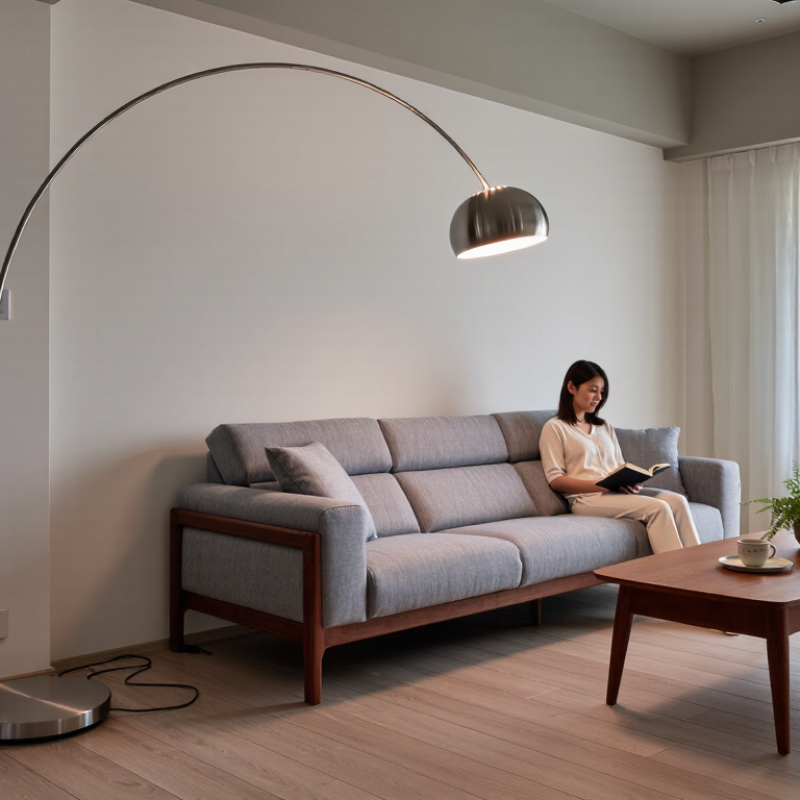
Arc Floor Lamps can bring reading light over a sofa without requiring a ceiling fixture, but their sweeping shapes can be easy to misjudge. A lamp that looks graceful online may crowd a narrow walkway or place its shade too far from the chair. In 2026, choosing well still starts with the room, not the trend. Measure the seat, nearby table, ceiling height, and lamp footprint before comparing finishes.

Look for a steady, weighted base and an arm that reaches where you actually read. Check whether the shade directs light downward, whether its height adjusts, and whether the bulb and dimming controls suit your habits. Product listings should state dimensions, materials, bulb compatibility, and care details. Unclear specifications deserve a closer look. That matters. Also consider the cord route, especially beside a doorway or rug. A beautiful lamp can become irritating when its plug crosses the only clear path.

This guide compares practical features, styles, and common trade-offs to help you choose an arc floor lamp for your space and budget. Some rooms need broad ambient light; others need a focused pool on a book. There is no single best model. Personal preference still counts: a slightly imperfect finish may feel warmer than a technically perfect lamp. The right choice should fit safely, light the task, and feel natural in daily use.
How to Choose the Best Arc Floor Lamp in 2026?

Define the Lighting Task Using the 300–500 lx Reading Benchmark

For reading, use 300–500 lx as a practical target on the page, not as a brightness rating for the bulb. Lux describes light reaching a surface. An arc lamp may look bright across the room yet leave a book dim if its shade sits too high or points away.

Place the lamp beside or slightly behind your reading seat, then aim the shade toward the open pages. Keep the beam off your eyes and check for glare on glossy paper. Measure at page level with a light meter, if available; phone apps can offer only rough estimates. Measure twice. A reading near 300 lx may suit a bright room, while 500 lx can help when surrounding light is low.

The right level depends on print size, contrast, eyesight, and personal comfort. Start within the range, then adjust the lamp and dimmer while reading for several minutes. Notice whether your hand casts a shadow or your eyes begin to strain. I would not treat one measurement as a perfect answer; meter placement and changing daylight can shift the result. A lamp that reaches the target comfortably is more useful than one that merely looks dramatic.

How to Choose the Best Arc Floor Lamp in 2026? - Define the Lighting Task Using the 300–500 lx Reading Benchmark

Lighting task Practical illuminance target Where to assess it Arc-lamp planning consideration How to check the result
Reading a printed book or magazine 300–500 lx On the open page in the usual reading position Position the lamp head so light reaches the page without shining directly into the reader’s eyes. Measure at page level with a lux meter while seated in the normal position.
Reading with reduced ambient room lighting 300–500 lx on the page On the page, with the room’s usual background lighting switched on A dimmer can help adjust the lamp as ambient light changes; avoid making the page bright while the surrounding room remains uncomfortably dark. Check the page and surrounding area separately; the reading target applies to the task area.
Light writing or note-taking 300–500 lx Across the writing surface Allow enough reach for the arc to place the light over the desk or side table, while keeping the base stable and out of walkways. Take readings at several points on the work surface to spot uneven lighting.
General seating-area illumination About 100–200 lx At the seating area or nearby horizontal surfaces Use a shade that distributes light comfortably; a floor lamp may supplement, rather than replace, room lighting. Measure at the surface where light is needed, not directly beneath the bulb or shade.
Close-up hobby or detailed handwork About 500 lx or more, as needed On the detailed work area Look for adjustable positioning and brightness, and arrange the beam to reduce hand shadows and glare. Increase illumination gradually and recheck for reflections, eye discomfort, and shadows.
Glare and placement check No single lux target From the normal seated viewpoint and across the task surface Confirm that the shade does not obstruct movement or create direct glare; check that the lamp’s arc clears furniture and overhead obstacles. Test the lamp from the actual seating position and at the intended shade height.

Planning note: Lux (lx) measures illuminance on a surface. The 300–500 lx reading range is a practical task-lighting benchmark, not a guarantee of comfort for every reader. Results depend on room lighting, shade design, lamp position, surface reflectance, and eyesight. Measure at the page or work surface, and follow applicable local electrical and product-safety guidance.


Measure Arc Reach and Ceiling Clearance Against the Room Layout

An arc floor lamp should reach the seat or table without forcing its base into a walkway. Sketch the room, then measure from the proposed base position to the center of the reading chair or tabletop. Check the lamp’s horizontal reach, not just its advertised overall width; those dimensions can describe different things. A tape measure stretched across the floor makes the reach easier to picture. Measure twice.

Mark the base and shade positions with painter’s tape. This simple mock-up can reveal collisions with a sofa arm, cabinet, or opening door before you buy. For ceiling clearance, compare the lamp’s full height and shade profile with the ceiling, including any sloped sections. Leave enough room to move the shade without scraping the ceiling. If people will walk beneath the arc, check head clearance along that route, not only directly above the furniture. For dining areas, place the shade over the table while keeping it clear of seated guests’ sightlines. Product measurements may not show how far the shade hangs below the arm, so check a dimension drawing or confirm that measurement. Room plans are imperfect, and a few inches can matter. Recheck your marks with furniture in its usual position.

Compare Brightness and Color Quality: Lumens and ENERGY STAR CRI ≥80

When comparing arc floor lamps, treat lumens as a starting point, not a promise of comfort. Lumens measure total light output; the shade, bulb position, and distance from your chair affect how bright the light feels. For reading beside a sofa, compare the lamp’s output with the room’s other lighting, then test whether the page is clear without glare. A dimmer helps when one setting feels harsh at night. Check the label.

Color quality matters too. Look for a color rendering index, or CRI, of at least 80; this helps everyday colors appear more natural than under lower-CRI light. ENERGY STAR requirements can vary by product category, so verify the current qualification and specifications on the product label rather than assuming every lamp meets the same criteria. If possible, compare a familiar object under the lamp, such as a red book cover or a blue cushion. The difference may be subtle, and warm or cool color temperature can change the impression. One imperfect point: CRI alone cannot tell you whether the light will feel pleasant in your room. Check both the rating and the actual light, ideally after dark.

Estimate Operating Cost with the DOE Formula: Watts × Hours ÷ 1,000

To estimate an arc floor lamp’s electricity use, apply the DOE formula: watts × hours ÷ 1,000. Use the lamp’s actual input wattage, shown on its label or in its manual, rather than a bulb’s brightness rating. A 100-watt lamp running five hours each evening uses about 0.5 kilowatt-hours per day. Over 30 days, that is roughly 15 kilowatt-hours. Multiply that figure by your electricity rate to estimate the monthly cost. At 16 cents per kilowatt-hour, the example costs about $2.40 a month.

Small details can change the estimate. A dimmer may reduce consumption, but the amount depends on the lamp and bulb. If you often adjust brightness, a plug-in energy meter can show real use more clearly. Check whether the lamp has one bulb or several, and add their wattages when appropriate. The calculation is an estimate, not a bill prediction; standby use, changing rates, and daily habits can shift the result. I would keep a week of notes, too. People tend to guess their evening hours low.

How to Choose the Best Arc Floor Lamp in 2026? — Estimate Operating Cost with the DOE Formula: Watts × Hours ÷ 1,000

Compare estimated annual electricity costs for lamps rated at 20, 30, 40, and 60 watts. Estimates assume 4 hours of use per day, 365 days per year, and an illustrative electricity rate of $0.16 per kilowatt-hour. Energy use is calculated with the DOE formula: watts × hours ÷ 1,000. Actual costs depend on your usage and local electricity rate.

Verify Electrical Safety Under UL 153 for Portable Luminaires

When choosing the best arc floor lamp in 2026, check its electrical safety before comparing finishes or shade shapes. UL 153 covers portable electric luminaires, including many floor lamps. Look for a certification mark on the lamp, packaging, or instructions, and match the model number with the certifier’s online directory. A seller’s claim alone is not enough. It is easy to focus on the shade and overlook the label.

Inspect the cord, plug, switch, and socket for damage or loose parts. Check that the lamp’s maximum wattage matches the bulb you plan to use. An arc lamp’s extended arm can shift its balance, so place it on a firm, level floor and keep the base clear of walkways. Certification does not guarantee safe placement or careful use. Small details matter.

Tips: Read the instructions before assembly. Confirm the lamp’s rated voltage and bulb limits. If the label is missing or unreadable, pause and ask the seller or manufacturer for documentation. A little checking now can prevent an avoidable problem later.

Our story

When The Light Went On

The idea for Acrospire was formed in 2012 when founder Tim envisioned a different kind of lighting manufacturer: one that would not only deliver outstanding customer experiences but also prioritise fair treatment for its employees.

We’ve come a long way

Working from any nook and cranny we could find

Motivated by the belief the industry wanted and needed better, Tim shared his plan to establish his own venture with Hatty, who simply couldn't let him do it alone.

The rest, as they say, is history.

Protecting local jobs and ensuring the best quality possible.

The products sold should, where possible be manufactured here in the UK

Working from a rented office by day and assembling lanterns in a garage at night, Tim and Hatty set to work.

11 Years later

and a lot has changed

Acrospire now inhabits a 14000² ft manufacturing facility in Basingstoke, Hampshire. We’re a proud partner of the Made in Britain scheme, ISO9001 certified and a member of all relevant lighting industry trade bodies.

We've built a reputation to be proud of

Along with great relationships with our customers and a great team! We've attracted some of the most experienced members of the lighting industry, all by following one golden rule.

A simple ethos

Creating work to be proud of

That runs through all that we do. Customers who have made the switch to Acrospire have found working with us to be a breath of fresh air.

Market leading warranty

If you’re a professional in the lighting industry, you’re probably familiar with warranties that range from 3 to 10 years, with extensions available on special request or at additional cost. At Acrospire, where we’re proud to be different, we offer a market-leading simple 12-year warranty, as standard.

Tight Control on Quality

We focus on our customers not our competition. We manufacture our products in the UK: with the exception of our solar products, our supply chain is within a 60-mile radius of our factory in Basingstoke: to maintain greater control over quality. We al

Speed is key

Speed of response is crucial when it comes to resolving warranty issues. If we’ve made a mistake, we own it, get to the root cause, and fix it as quickly as possible. We believe in timely communication with our customers and making the resolution pro

Test and Test Again

We believe in independent testing and certification. Our new product development is in line with ISO 9001. Many of our products hold ENEC Certification. To meet the requirements of ENEC we also send random product samples for third party safety testi

Quality by design

Our product design is another key factor in our ability to offer a 12-year warranty. We value engineer rather than cost cut, never compromising on quality. We stick to our processes and engage with our supply chain to ensure that every product meets