How to Choose China Top RGBW Floodlights?
Choosing China’s top RGBW floodlights requires more than comparing brightness and factory prices. The best fixture depends on your project, climate, control system, and lighting goals. RGBW floodlights combine red, green, blue, and dedicated white LEDs. This design creates vivid colors and more natural white illumination. It suits building façades, gardens, bridges, stages, hotels, and public spaces. Yet, product photos rarely reveal heat management or long-term color stability.
A practical evaluation should begin with LED quality, optical lenses, housing materials, and power efficiency. Check the beam angle carefully. A narrow beam can highlight columns, while a wide beam spreads light across walls. Ask suppliers for lumen data, color temperature options, dimming performance, and tested IP ratings. IP66 protection may be suitable for exposed outdoor installations, but local conditions still matter. Salt air, dust, frost, and installation height can change the result.
Supplier credibility is equally important. Review factory experience, sample quality, production controls, warranty terms, and after-sales support. Request test reports from recognized laboratories when available. Confirm whether the control protocol matches your system, such as DMX512, DALI, or wireless control. A sample should run for several hours before bulk purchasing. Watch for flicker, uneven color mixing, excessive heat, and loose cable glands.
There is no single “top” model for every buyer. I have found that attractive specifications can hide practical weaknesses. A slightly higher initial cost may reduce maintenance later. Still, every claim deserves verification. Careful testing turns a promising quotation into a dependable lighting decision.
What Are RGBW Floodlights and How Do They Work?
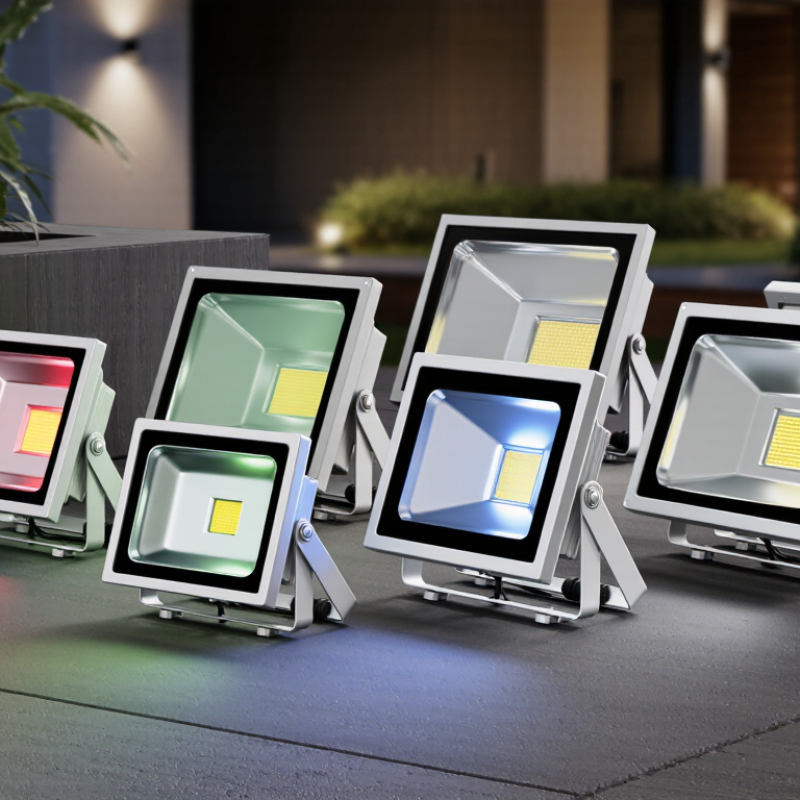
RGBW floodlights combine red, green, blue, and white LED chips in one fixture. RGB channels create colored light through additive mixing. The dedicated white channel produces cleaner illumination than mixing red, green, and blue alone.
A controller adjusts each channel’s intensity through DMX, wireless signals, or programmed scenes. For example, red and green can create amber, while blue and white can produce a cool architectural wash. The white LED also improves color rendering and reduces the dull appearance common in RGB-only fixtures. That matters.
The International Energy Agency reported that lighting consumed about 15% of global electricity use in 2022. Efficient control and optics therefore deserve attention, not only maximum wattage. The U.S. Department of Energy’s solid-state lighting research reports identify higher efficacy, improved color quality, and better thermal management as key development priorities. In field testing, inspect beam uniformity, white-light color temperature, dimming stability, and housing temperature. Measure it.
A strong RGBW floodlight should maintain consistent color across multiple units. Check photometric files, ingress protection testing, driver specifications, and lifetime data under stated temperatures. Manufacturer claims can look impressive, but installation conditions often differ. I would also question very high lumen figures without test standards or thermal details. Good selection requires evidence, not colorful demonstrations alone.
Which Technical Specifications Matter Most in RGBW Floodlights?
When choosing China’s top RGBW floodlights, do not start with wattage. The most useful figure is delivered lumens at the intended RGBW mix. The U.S. Department of Energy’s Lighting Facts database has listed many LED products above 100 lm/W, yet colored output can reduce system efficacy. Request separate white-channel lumens, power, and CCT. Check CRI and R9 for skin tones and architectural materials. For color uniformity, ask for initial and maintained chromaticity data, ideally with SDCM tolerance. IES LM-80 requires at least 6,000 hours of LED package testing, while TM-21 projects lumen maintenance. A short factory burn-in is not equivalent. Not even close.
Outdoor reliability needs measurable evidence.
IEC 60529 defines IP66 as dust-tight protection against powerful water jets. IEC 62262 rates IK08 at five joules of impact energy. Thermal data matters because sealed housings trap heat. Ask for case temperature, ambient range, and the calculation behind any 70,000-hour claim. Control specifications deserve equal scrutiny: DMX512 compatibility, 8-bit or 16-bit dimming, PWM frequency, and color-mixing calibration. For camera-visible installations, request flicker results using Pst LM and SVM, not “flicker-free.” Inspect a sample after rain, heat cycling, and repeated color changes. Datasheets sometimes omit white-channel output at full RGB saturation. That omission can distort project sizing and deserves careful questioning.
How to Evaluate China-Based RGBW Floodlight Manufacturers
Choosing a China-based RGBW floodlight manufacturer requires more than comparing unit prices. Ask for production records, engineering drawings, and test reports for the exact model. A polished website proves little. Request a sample from the same production line. Inspect color mixing, beam consistency, housing finish, and cable glands under real operating conditions. Small details matter. Loose connectors and uneven lenses may appear after several hours, not during a quick demonstration.
Evaluate technical capability through measurable data. The manufacturer should state LED binning, color temperature, lumen output, power tolerance, dimming protocol, and expected lifetime. Check whether lifetime claims include ambient temperature and drive current. Thermal testing is especially important for outdoor fixtures. Ask for operating-temperature records, ingress-protection testing, surge protection, and corrosion resistance. Independent laboratory reports become more credible when they show test dates, sample numbers, and applicable standards. Still, paperwork can mislead. Verify critical claims through third-party inspection for large projects.
A reliable supplier also manages communication after the sale. Review response times, spare-part policies, warranty exclusions, packaging methods, and batch traceability. Request references from comparable outdoor installations, not only indoor displays. Discuss lead times in writing, including approval samples and replacement procedures. A factory audit can reveal weak housekeeping or manual quality checks, but it is only a snapshot. Keep an acceptance checklist and test delivered units before installation. Record results with photos, serial numbers, and ambient conditions.
What Quality, Safety, and Certification Standards Should You Check?
How to Choose China Top RGBW Floodlights?
When choosing RGBW floodlights, inspect safety evidence before comparing colors or prices. Ask for test reports from an ISO/IEC 17025-accredited laboratory. Check IEC 60598-1 and IEC 60598-2-5 compliance for lighting construction and floodlight safety. EMC tests should reference IEC 55015 and IEC 61547. These documents should match the exact model, power rating, and LED configuration.
Look for an IP66 or IP67 rating when fixtures face rain, dust, or irrigation spray. IK08 or IK10 protection helps resist accidental impact. Examine cable glands, grounding points, sealing rings, and the glass edge. The housing should release heat through a properly designed aluminum body, not only through decorative fins. Ask for surge protection details, insulation class, operating temperature, and photobiological safety testing under IEC 62471. Small omissions matter.
Certification marks need verification. CE, RoHS, CB, or local approvals may apply differently by destination market. A certificate alone is not enough. Request the certificate number, scope, test date, and factory quality records. Check whether production uses the same driver and control system shown in the report. For RGBW performance, test white output, color consistency, dimming smoothness, and visible flicker at several camera settings. I have seen attractive samples change color after long operation. That risk deserves a thermal test, a rain simulation, and several weeks of real installation feedback. Documents can be imperfect. Your inspection should not be.
How to Choose China Top RGBW Floodlights?
Quality, Safety, and Certification Standards to Check
How to read the chart: Under IEC 60529, the first IP digit measures protection against solid objects and dust, while the second digit measures protection against water. A higher number indicates a higher protection level within that category. IP65 means dust-tight protection and protection against water jets; IP66 adds protection against powerful water jets.
Recommended checks for RGBW floodlights: Verify an IP test report issued for the complete luminaire, not only for individual parts. For outdoor or public installations, also review IEC 60598-1 and IEC 60598-2-5 safety compliance, IEC 62262 impact protection where mechanical damage is possible, and EMC evidence such as CISPR 15, IEC 61547, and IEC 61000-3-2/-3-3. For EU sales, check applicable CE technical documentation and RoHS compliance.