How to Choose the Best LED Lighting for Your Business?
Choosing the best LED lighting for your business involves more than replacing old bulbs. It requires matching light quality, energy use, controls, maintenance, and safety with daily operations. A bright showroom needs different performance from a warehouse aisle or a quiet hotel corridor. The right decision starts with the task, not the product box.
The U.S. Department of Energy reports that LED lighting can use at least 75% less energy and last up to 25 times longer than incandescent lighting. ENERGY STAR also emphasizes measured efficiency, certified performance, and suitable product quality. These figures matter when electricity bills, maintenance hours, and replacement access affect operating costs. Still, payback is not automatic. Poor installation, excessive brightness, unsuitable color temperature, or weak controls can reduce the expected benefit.
Look beyond wattage. Compare lumens, efficacy, color rendering index, correlated color temperature, glare control, beam angle, and expected lifetime. For demanding facilities, verify photometric testing under standards such as IES LM-79 and LM-80, where applicable. Check warranties, driver quality, dimming compatibility, emergency requirements, and protection ratings for dusty or damp areas. Field teams often find that one fixture cannot serve every room. That lesson deserves attention.
A useful evaluation should include the purchase price, installation labor, energy savings, maintenance, and disposal considerations. Local utility incentives may also change the final calculation. The “best” option is rarely the most powerful one. It is the system that delivers comfortable, reliable light with measurable value over time. Some assumptions will be wrong, so pilot testing one zone before a full rollout remains a sensible step.
Define Your Business’s Lighting Needs and Operating Goals
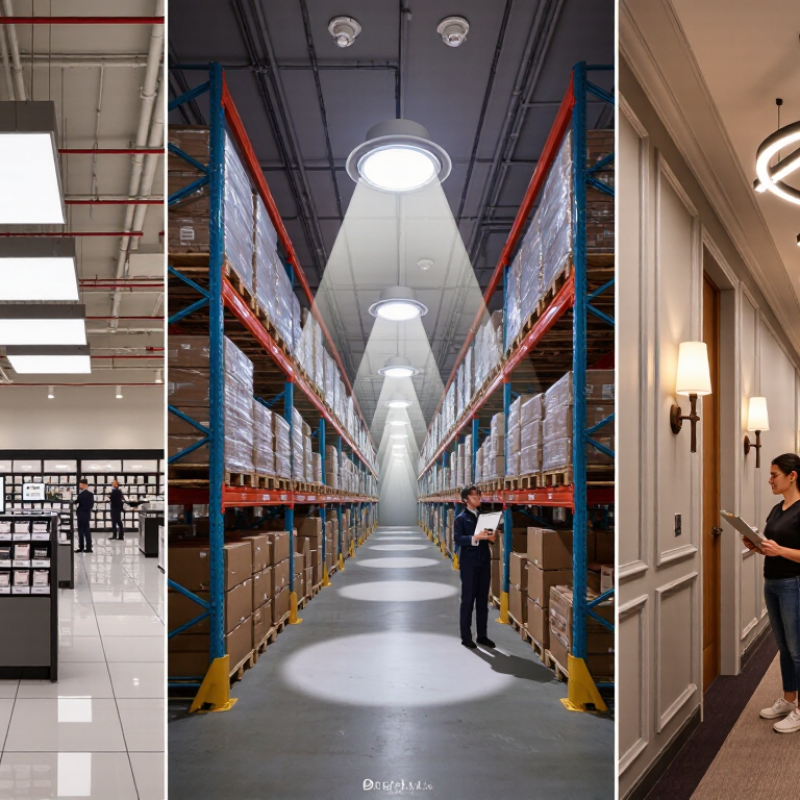
Before choosing LED fixtures, define what each space must accomplish. A warehouse needs clear aisles and safe movement. A restaurant may need warm light, accurate food colors, and controlled glare. A small office may prioritize visual comfort during eight-hour shifts. Measure room dimensions, ceiling height, existing lux levels, operating hours, and occupancy patterns. Measure the room first. Guessing is expensive.
Set measurable operating goals rather than asking for “brighter” lighting. Specify target illuminance, color temperature, color-rendering quality, acceptable glare, maintenance access, and control requirements. Motion sensors can reduce unnecessary operating hours in storage areas, while daylight controls may support perimeter offices. The International Energy Agency’s Energy Efficiency 2023 report states that LED lamps represented more than half of global lamp sales in 2022. This shows market maturity, but it does not make every LED suitable for every task.
Compare total operating cost, not just purchase price. The U.S. Department of Energy’s 2023 Solid-State Lighting R&D Opportunities report documents LED packages exceeding 200 lumens per watt in laboratory conditions. Real installations usually perform below laboratory results because of optics, heat, controls, and dirt. That gap deserves attention. A lower-wattage fixture can still fail if it produces uneven light or frequent replacements. Review photometric files, warranty terms, driver performance, and five-year energy estimates. Do not ignore worker feedback. A spreadsheet may show savings, while employees notice flicker, reflections, or shadows first.
Compare LED Fixture Types, Brightness, and Color Quality
How to Choose the Best LED Lighting for Your Business?
The right LED fixture depends on the room, ceiling height, and daily tasks. Flat panels suit offices with regular ceilings and even light distribution. Linear fixtures work well above counters, aisles, and workstations. High-bay fixtures are better for warehouses with tall ceilings. Downlights can highlight displays, but poor spacing may create bright circles and dark gaps.
Brightness should be measured in lumens, not wattage. A lux meter can show whether desks, shelves, or production areas receive enough light. Too little brightness causes eye strain. Too much creates glare on screens and polished surfaces. In one office review, the fixtures looked powerful, yet desks remained dim because their beams missed the work areas. I nearly overlooked that detail.
Tips: Compare fixture layouts before comparing prices. Check beam angles, diffuser quality, dimming control, and maintenance access. For color quality, choose a suitable color temperature and a high CRI for accurate visual work. Neutral white often supports offices and retail spaces. Warmer light may feel comfortable in hospitality areas. Test samples beside real products, wall colors, and flooring. Color can appear different after sunset. Ask a qualified lighting professional to verify electrical safety and local requirements.
How to Choose the Best LED Lighting for Your Business?
Compare typical LED fixture performance by luminous efficacy, color rendering, and service life. Higher efficacy produces more light per watt, while a higher CRI delivers more accurate colors.
Values represent typical commercial LED fixture ranges. Actual performance varies by design, installation conditions, operating temperature, and application.
Check Compatibility, Controls, Safety, and Installation Conditions
How to Choose the Best LED Lighting for Your Business?
Choosing LED lighting starts with compatibility, not brightness. Check the existing voltage, socket type, fixture size, and wiring condition before ordering. A lamp may fit physically but still fail with an older driver or dimmer. Ask for the product’s electrical specifications and compare them with your installation. When uncertain, have a qualified electrician inspect the circuit.
Controls also deserve careful attention. Confirm whether the lights support dimming, motion sensors, timers, or building automation. Different control systems can cause flicker, delayed startup, or reduced lamp life. Test one fixture before changing an entire room. I once assumed a dimmer would work because the lamp appeared compatible. It did not. That small mistake caused extra labor and an uncomfortable meeting.
Tips: Measure the space. Photograph the wiring. Record ceiling height and operating hours. For kitchens, workshops, or outdoor areas, check moisture, dust, heat, and impact ratings. Keep drivers away from trapped heat, and leave service access where possible. Safety should guide installation conditions. Check emergency lighting requirements, grounding, cable capacity, and fire-clearance limits. Never place a fixture near heat-producing equipment without confirming its temperature rating. A clean installation should have secure connections, even spacing, and no exposed conductors. Review the result after one week; glare, shadows, or unexpected noise may reveal problems that a daytime inspection missed.
Calculate Total Costs and Select the Best LED Lighting Solution
Choosing the best LED lighting for a business starts with total cost, not the fixture price. The U.S. Department of Energy reports that LED products can use at least 75% less energy and last up to 25 times longer than incandescent lighting. However, commercial projects often replace fluorescent or metal-halide systems, so the savings may be smaller.
Calculate annual energy cost with this formula:
fixture watts × quantity × operating hours ÷ 1,000 × electricity rate.
Use a real example. Replacing 100 100-watt fixtures with 40-watt LEDs, operating 3,000 hours yearly at $0.15 per kWh, saves about $2,700 annually. Add installation, controls, maintenance, disposal, and possible rewiring costs. If the complete project costs $12,000, the simple payback is about 4.4 years, before maintenance savings.
The International Energy Agency identifies lighting efficiency as an important electricity-saving opportunity, but actual results depend on occupancy and operating habits. Controls matter.
Do not trust the first spreadsheet.
Check light levels, glare, color quality, emergency requirements, and compatibility with dimmers. A cheaper fixture may create dark aisles or frequent replacements. I once underestimated lift-equipment costs; the payback changed noticeably. Request photometric files, warranty terms, rated life, and lumen-maintenance data. Select the solution with the lowest credible lifecycle cost, not merely the lowest purchase price.