Which Is the Best EV Power Station in 2026?
Which Is the Best Ev Power Station in 2026? The answer depends on what “power station” means for your driving. A home wallbox, public fast charger, and battery-backed portable unit solve different problems. Their prices and charging speeds are not directly comparable.
The market is growing quickly. The International Energy Agency’s Global EV Outlook 2025 reports that electric-car sales exceeded 17 million in 2024, reaching more than 20% of new-car sales worldwide. The report expects sales to surpass 20 million in 2025. IEA Executive Director Fatih Birol has described electric cars as “the key technology to decarbonise road transport.” That growth makes dependable charging equipment increasingly important, but it does not make every charger a good fit.
This guide compares practical choices, not just headline wattage. It examines charging speed, connector compatibility, usable battery capacity, safety features, weather protection, portability, and total cost. A unit that looks powerful on a product page may charge slowly in real conditions. Cable reach matters, too. So does whether the station can support your vehicle’s charging standard. We will distinguish fixed chargers from portable power stations, since the names can blur together. The best Ev Power Station is the one that suits your vehicle, daily route, and available power supply. There is no perfect pick for everyone. Some specifications are also difficult to compare across brands, so check manufacturer documentation before buying.
Understanding EV Power Stations and Their Main Functions
Which Is the Best EV Power Station in 2026?
An EV power station supplies electricity to a vehicle through a controlled charging connection. It does more than pass power from a socket to a battery. The equipment checks the connection, communicates charging limits, and helps prevent unsafe current flow. That distinction matters. With AC charging, the vehicle’s onboard charger converts incoming power for the battery. A DC fast-charging station performs that conversion outside the vehicle, allowing higher charging rates when the car supports them.
At home, a compact AC unit can charge a car overnight, while public stations may offer different speeds and payment methods. Some systems also track energy use, schedule charging for quieter hours, or share limited power between several vehicles. A useful choice depends on the car’s charging capacity, the electrical supply, and how often charging is needed away from home. Check connector compatibility and installation requirements before comparing speed claims. A high rated output cannot make every vehicle charge faster. It’s easy to overlook that. I would also leave room for uncertainty: charging time changes with battery temperature, state of charge, and the vehicle’s own controls. The numbers on a product page are only part of the picture.
Types of EV Power Stations Available in 2026
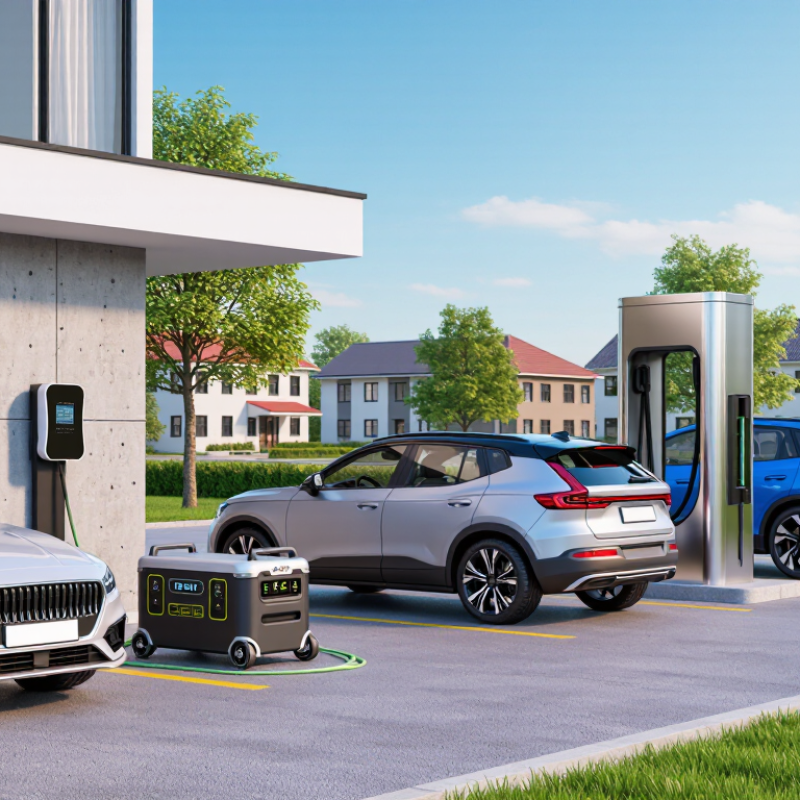
In 2026, “EV power station” may describe a home charger, a public charging unit, or a battery-based portable system. They serve different needs. Home AC chargers, often called Level 2, suit overnight charging where a dedicated circuit is available. Charging speed depends on both the unit and the vehicle’s onboard charger, so a high-rated station does not guarantee faster charging.
Public DC fast-charging stations send power directly to the vehicle’s battery. They are useful on longer trips, but charging speed can drop as the battery fills or gets hot. Portable power stations are different: they store electricity and may support limited emergency charging, depending on their output and the car’s requirements. They are not automatically a practical substitute for a fixed charger. That distinction is easy to miss.
Solar-integrated systems combine panels, storage, and charging equipment. They can make use of surplus daytime generation, though cloudy weather and household demand affect how much energy is available. For a real comparison, check connector compatibility, power output, installation needs, and the vehicle’s charging limits. A tidy display looks reassuring. Still, I would not choose by screen features alone; cable reach and charging behavior matter during an ordinary week.
Key Criteria for Comparing EV Power Stations
Compare an EV power station by the power your vehicle can actually accept, not just the largest number on its label. Check its rated output, your car’s onboard charger limit, and the capacity of the home circuit. An 11-kilowatt unit offers little benefit if your vehicle draws only 7 kilowatts. Small mismatch, real cost. Confirm connector compatibility and cable reach; a cable that barely reaches the driveway can make daily charging frustrating. If other appliances run at the same time, load balancing may help prevent the household circuit from being overloaded.
Safety and installation matter as much as charging speed. Look for clear electrical ratings, built-in protection features, and a weather rating suited to the planned location. Check whether the unit needs a dedicated circuit and have a qualified electrician assess the installation. Smart scheduling can shift charging to quieter hours, but only if the controls are simple enough to use. I would not assume every app or display makes charging easier; that part is easy to overlook. Compare warranty terms, support availability, and total installed cost, not just the unit’s purchase price. A slower charger may be the more practical fit.
How Leading EV Power Stations Differ in 2026
In 2026, EV power stations differ less by appearance than by the jobs they can handle. The International Energy Agency’s Global EV Outlook 2025 reported more than five million public charging points worldwide at the end of 2024, with over 1.3 million added that year. That growth makes location and charger type important: a compact AC unit may suit an overnight workplace, while a high-output DC station better serves a busy roadside stop. The US Department of Energy’s Alternative Fuels Data Center lists typical DC fast-charging power from 50 kW to 350 kW or more. Higher ratings can shorten stops, but only when the vehicle and electrical supply support them.
Compare real operating limits, not just peak figures. Check connector compatibility, simultaneous charging capacity, load management, and performance in heat or cold. A station’s screen may show an impressive number; sustained output is what drivers feel. Small details matter. A cable that reaches the next parking bay can save awkward repositioning. For site operators, grid capacity and installation costs may matter more than maximum speed. My comparison has one limitation: published specifications rarely show performance under every local condition. Look for independent test results and clear service terms, then match the station to actual traffic patterns rather than an idealized peak.
Choosing the Best EV Power Station for Your Needs
The best EV power station in 2026 is not necessarily the fastest one; it is the unit that fits your car, parking setup, and daily routine. Check your vehicle’s connector and maximum AC charging rate before comparing station output. A higher-rated unit cannot make a car accept more power. Confirm the electrical supply and installation requirements with a qualified electrician, especially in older homes. This matters. A driveway charger exposed to rain, winter salt, or direct sun needs suitable environmental protection. A shared garage may need access controls and careful cable routing.
Think about when you charge. If your car sits overnight, dependable scheduling and load balancing may matter more than peak speed. For multiple drivers, simple user access and energy tracking can prevent confusion. Review warranty coverage, software support, and installation costs, not just the hardware price. Ask whether the station can manage household demand when an oven or heat pump is running. Small details count: cable reach to the charging port, a readable status light, and a mount that keeps the connector off wet ground. I would not choose from headline specifications alone; actual needs vary by commute, climate, and electrical capacity. That judgment may change after a month of use.
Which Is the Best EV Power Station in 2026?
Choosing the Best EV Power Station for Your Needs
Estimated range is calculated using 85% of rated station capacity as energy delivered to the vehicle and an assumed EV consumption of 0.30 kWh per mile. Actual range varies with the vehicle, temperature, charging equipment, and conversion losses. Check that a power station supports your EV’s charging equipment before use.